PhD IN AI AT IIT DELHI 2026: Explore eligibility, admission process, research areas, GATE requirements, part-time PhD and application details.PhD IN AI AT IIT DELHI
If you are planning to pursue a PhD in Artificial Intelligence, Machine Learning or Data Science, there is one important question you should ask before applying:
Do you need to come from a pure Computer Science or Artificial Intelligence background?
At the Yardi School of Artificial Intelligence (ScAI), IIT Delhi, the answer is not necessarily.
This multidisciplinary approach makes the PhD programme particularly interesting for candidates who want to use AI to solve research problems in different application domains.
In this guide, we cover the Yardi School of Artificial Intelligence, its research areas, eligibility requirements, full-time and part-time PhD routes, selection process and application timeline.
About the Yardi School of Artificial Intelligence at IIT Delhi
The Yardi School of Artificial Intelligence (ScAI) was established at IIT Delhi in 2020 to strengthen research and education in Artificial Intelligence, Machine Learning and Data Science.
However, AI at ScAI is not treated as a subject that exists in isolation.
The School follows a multidisciplinary approach, allowing researchers to apply artificial intelligence to problems across different domains.
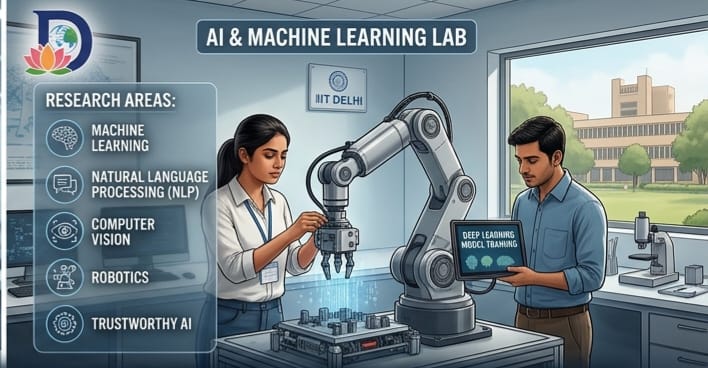
Some of the application areas include:
- Healthcare
- Robotics
- Materials and energy
- Weather and Earth observation
- Transportation
- Scientific computing
- Management
- Social sciences
This means your PhD research does not necessarily have to focus only on developing a new AI model.
You could instead explore questions such as:
- How can AI improve healthcare?
- How can machine learning support robotics?
- How can AI help address climate and Earth-observation problems?
- How can AI improve transportation and mobility?
- How can AI be applied to management or social-science problems?
The important question is therefore not simply:
“Do I want to pursue a PhD in AI?”
Instead, ask:
“What research problem do I want to solve using AI?”
Research Background and Interdisciplinary Opportunities
IIT Delhi’s current research description encourages applicants who either have strong depth in AI or have demonstrated experience working at the intersection of an application area and AI.
This makes the programme particularly relevant for applicants coming from different academic backgrounds who can demonstrate a meaningful connection between their expertise and artificial intelligence.
Your research direction should therefore be clear before you begin the application process.
IIT Delhi PhD Eligibility
For full-time PhD admissions, eligibility depends on your qualifying degree.
Master’s Degree: M.Tech, M.E., M.D. or Equivalent
Candidates with qualifications such as:
- M.Tech
- M.E.
- M.D.
- Equivalent qualification
generally require a minimum of 60% marks.
Under this route, a national-level qualifying examination is not required, according to the requirements covered in this guide.
Master’s Degree: M.Sc., M.A., M.B.A., M.B.B.S. or Equivalent
Candidates with qualifications such as:
- M.Sc.
- M.A.
- M.B.A.
- M.B.B.S.
- Equivalent qualification
generally require:
- 60% marks, and
- Qualification in a relevant national-level examination, such as GATE or NET.
Direct Entry After Four-Year Bachelor’s Degree
There is also a direct-entry route for candidates holding a four-year:
- B.E.
- B.Tech.
- B.S.
- B.Sc.
- Equivalent qualification
Under this route, the general requirement is:
- 70% marks, and
- Qualification in a relevant national-level examination.
Exception for CFTI Students
There is an important exception for candidates from Centrally Funded Technical Institutes (CFTIs).
For eligible CFTI students, the national-level examination requirement may be waived if they have a CGPA of 8.0 or above.
Part-Time PhD at IIT Delhi
IIT Delhi also offers a part-time PhD route for working professionals.
The academic requirements are broadly similar, but the national-level examination requirement is waived under the part-time route.
However, depending on your qualifying degree and background, work-experience requirements may apply.
Working professionals also need to obtain a No Objection Certificate (NOC) from their employer.
The NOC confirms that the candidate:
- Is permitted to pursue the PhD
- Can devote the required time to coursework
- Can fulfil the requirements of research
Therefore, professionals should check both their academic eligibility and employment-related requirements before applying.
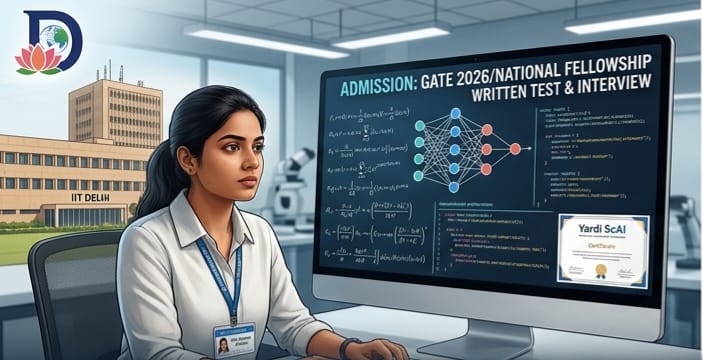
IIT Delhi PhD Admission Process
The selection process can broadly be understood through four stages:
Application → Shortlisting → Test/Assessment (where applicable) → Interview
Step 1: Application
Candidates submit their application along with the required academic and supporting information.
Step 2: Shortlisting
Shortlisting is based on criteria determined by the concerned School or Department.
This means that requirements can vary depending on the programme and research area.
Step 3: Written Test or Assessment
Shortlisted candidates may be invited for a written test and/or another assessment, depending on the programme’s admission criteria.
Step 4: Interview
Candidates who progress through the selection process may be called for an interview.
The assessment can evaluate areas such as:
- Subject knowledge
- Research aptitude
- Analytical thinking
- Understanding of research problems
Therefore, applicants should prepare for more than just completing the application form.
When Does IIT Delhi PhD Admission Open?
IIT Delhi normally advertises PhD admissions twice a year.
The admission cycles generally occur around:
- March
- October
The corresponding selection processes generally take place around:
- May
- December
However, admission dates and School-specific requirements can change.
Applicants should always check the latest IIT Delhi PhD admission notification before applying.
How to Prepare for an IIT Delhi AI PhD
If you are serious about pursuing a PhD in Artificial Intelligence at IIT Delhi, don’t start with the application form.
Start with your research direction.
1. Identify Your Research Area
Determine the specific area of AI that interests you.
For example:
- Machine Learning
- Data Science
- AI for Healthcare
- AI for Robotics
- AI for Climate
- AI for Transportation
- AI for Scientific Computing
2. Identify Relevant Faculty
Once you have identified your research area, find faculty members working in that field.
Study their recent research and publications.
3. Understand Their Research Problems
Don’t stop at simply looking at a faculty member’s research area.
Try to understand:
- What problems are they studying?
- What methodologies are they using?
- What research gaps exist?
- How does your background connect with their work?
4. Evaluate Your Research Fit
Finally, assess whether your:
- Academic background
- Research experience
- Technical skills
- Proposed research direction
fit the faculty member and the School.
What Makes a Strong AI PhD Application?
At the doctoral level, simply saying “I want to study AI” is not enough.
You should be able to clearly explain:
What do you want to research?
Why does the research problem matter?
How can AI help address it?
Why is IIT Delhi the right environment for your research?
A clear research direction can help demonstrate that you are prepared to think beyond coursework and toward independent research.
Full-Time vs Part-Time PhD at IIT Delhi
| Feature | Full-Time PhD | Part-Time PhD |
|---|---|---|
| Intended applicants | Full-time researchers/students | Working professionals |
| National-level exam | Depends on qualifying degree | Requirement waived |
| Work experience | Not the primary basis | May be required |
| Employer NOC | Generally not applicable | Required |
| Coursework & research | Full commitment | Must be managed alongside employment |
Specific requirements can vary according to the programme, School and applicant category.
Key Takeaways
If you are considering a PhD in Artificial Intelligence at IIT Delhi, remember:
- The Yardi School of AI follows a multidisciplinary approach.
- You do not necessarily need a pure AI or Computer Science background.
- AI can be applied to healthcare, robotics, climate, transportation, scientific computing, management and social sciences.
- Full-time eligibility depends on your qualifying degree.
- A Master’s route may require 60% marks depending on the degree.
- A four-year Bachelor’s direct-entry route generally requires 70% marks and a qualifying national-level examination.
- CFTI candidates with a CGPA of 8.0 or above may qualify for a waiver of the national-level examination requirement.
- IIT Delhi also has a part-time PhD route for working professionals.
- Part-time applicants require an employer NOC, and work-experience requirements may apply.
- Selection can involve application screening, a written test or assessment and an interview.
- PhD admissions are generally advertised twice a year, around March and October.
Final Thoughts
A PhD at the Yardi School of Artificial Intelligence, IIT Delhi can be an exciting option for candidates who want to use AI to address meaningful problems across different fields.PhD IN AI AT IIT DELHI
The most important thing to remember is that a PhD is not simply about studying a subject—it is about creating new knowledge.
So before you apply, don’t just decide that you want to “do a PhD in AI.”(PhD IN AI AT IIT DELHI
Identify the problem you want to solve.
Find the researchers working on that problem.
Understand their research.
And then determine whether your academic background, research experience and proposed research direction fit the School and faculty.
That is where your PhD strategy really begins.
At Zenith PhD Training and Consultancy, we help PhD applicants with university shortlisting, research direction, application strategy, SOP and research proposal development, and interview preparation.
Because your PhD journey is too important to figure out alone.
This article is intended for informational purposes only and is based on the information provided for this guide. IIT Delhi requirements, deadlines and School-specific criteria may change. Always verify the latest admission notification and programme requirements before applying.
Frequently Asked Questions
Do I need a Computer Science degree to pursue a PhD in AI at IIT Delhi?
Not necessarily. The Yardi School of Artificial Intelligence follows a multidisciplinary approach and encourages research at the intersection of AI and different application domains.
What percentage is required for a Master’s degree?
For the routes described in this guide, a minimum of 60% marks is generally required for the specified Master’s qualifications.
Can I apply directly after a four-year Bachelor’s degree?
Yes. A direct-entry route is available for candidates with a four-year B.E., B.Tech., B.S., B.Sc. or equivalent qualification, subject to the applicable requirements.
Is GATE or another national-level examination required?
The requirement depends on your qualifying degree and admission route. For the direct four-year Bachelor’s route, a qualifying national-level examination is generally required. Requirements differ for other Master’s routes and part-time applicants.
Does IIT Delhi offer a part-time PhD?
Yes. IIT Delhi has a part-time PhD route for working professionals, with applicable work-experience and employer NOC requirements.
How often does IIT Delhi conduct PhD admissions?
IIT Delhi normally advertises PhD admissions twice a year, around March and October, although applicants should always verify the latest notification.
PhD IN AI AT IIT DELHI
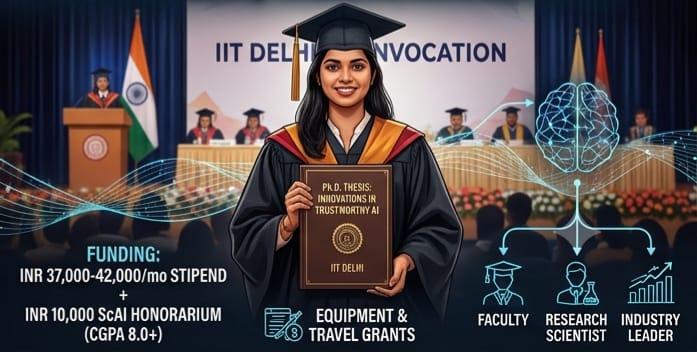
PhD IN AI AT IIT DELHI
FOR MORE BLOGS CLICK THE LINK GIVEN BELOW: